The Body as material began with two questions. As a group, we discussed a few answers in response and spoke of the following ideas;
WHAT IS THE BODY AS MATERIAL?
- Physicality
- Reflection
- Impulses
- Movement
WHAT IS PERFORMANCE?
- Acting
- Expression/Emotional outlet
- Communication/conversation
- Extension of self
- Documentation (Film/photography)
- Public/Private (Site specific)
- Audience Participation
We also spoke about if a performance is carried out in a public or private space, and the importance of the site. This was something I hadn’t really thought about before, but looking at examples of very different performance pieces, I became aware of how the setting can drastically change a performance. To be more specific, performing in a public space can possibly lead to unwanted reactions. Similarly, the audiences (or general public) participation could also be key to the artists work. I find it interesting to how we as humans react alone in comparison to in a group setting. The people we are around can hugely impact the way we act, and I feel that this has to be taken in to consideration when performing in public.
We were then split in to pairs and given a particular art work which uses the body, and had the task of finding out information on the work and its artist. My piece was ‘Finger Gloves’ by Rebecca Horn, performed in 1972.
Rebecca Horn is a German visual artist born in 1944. Growing up in a country heavily involved in the Second World War, Horn was forced to learn to speak a different language due to the backlash against Germans at this time. Because of this, the artist turned to drawing as her way of communicating.
“We could not speak German. Germans were hated. We had to learn French and English. We were always traveling somewhere else, speaking something else. But I had a Romanian governess who taught me how to draw. I did not have to draw in German or French or English. I could just draw.”
At the age of just 20, Horn went through an impossibly difficult time of her life. Along with losing her parents, she was put into a sanatorium after contracting lung poisoning from working with fibreglass without wearing a protective mask. While bed ridden, she began drawing which created a myriad of plans for her future sculpture works. Finger Gloves in particular was drawn as an idea 3 years before the performance was carried out.
‘FINGER GLOVES’ 1972
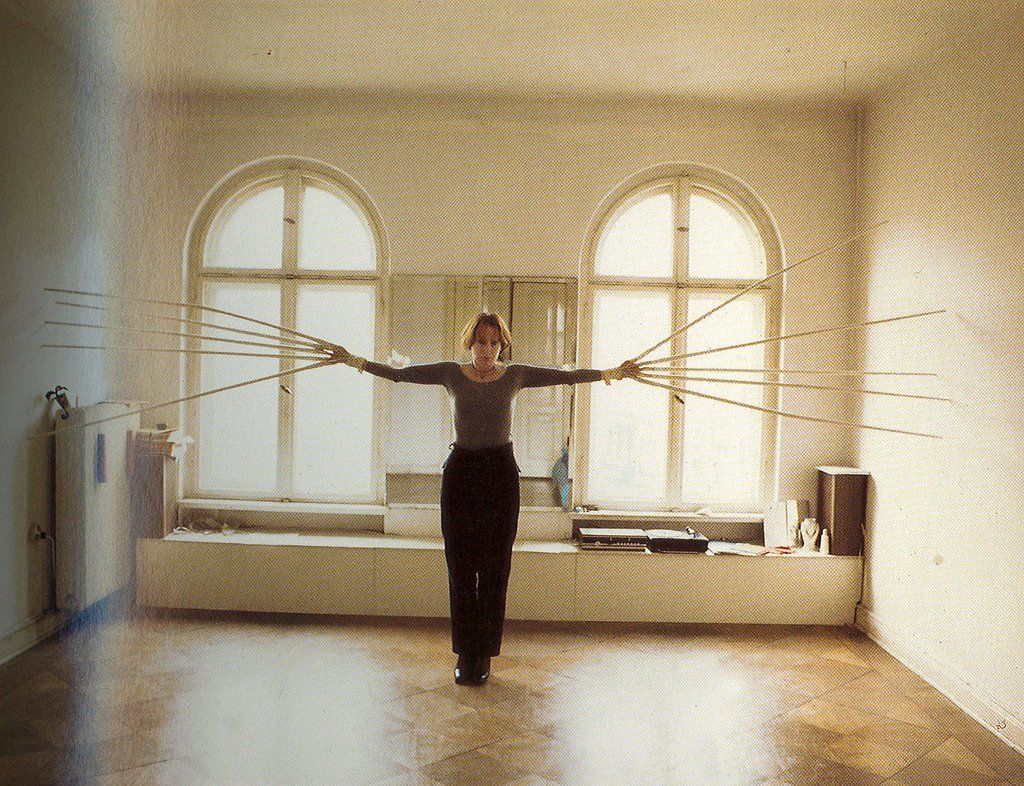
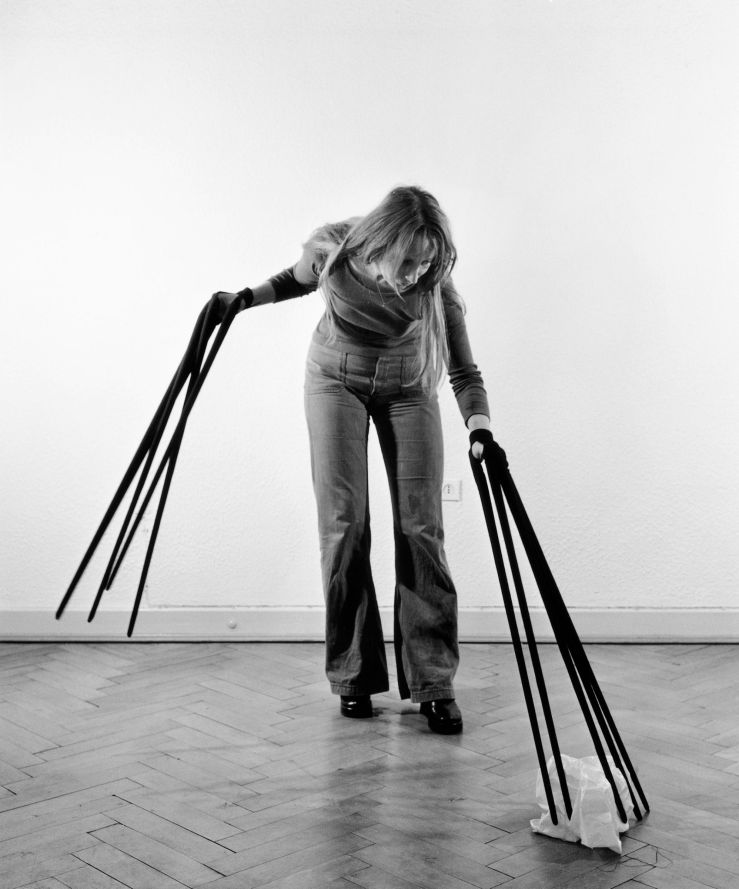
The art work ‘Finger Gloves’ is part of a series of extensions of the body (including ‘Trunk’, ‘Head Extension’, and ‘Arm Extensions’). It shows the artist walking down an empty room, wearing two black metre long prosthesis on each hand, each with five ‘fingers’ made from wood and fabric which are attached to the wrist by straps. Filmed through the doorway, she walks steadily through the middle of the white room wearing these gloves as they scrape the walls either side of her. The gloves audibly scrape on the walls, creating a sense of unease and an eerie atmosphere.
“The finger gloves are made from such a light material, that I can move my fingers without effort. I feel, touch, grasp with, yet keep a certain distance from the objects that I touch. The level action of the lengthened fingers intensifies the sense of touch in the hand. I feel myself touching, see myself grasping, and control the distance between myself and the object.”
The extension series is now displayed as documentation of the performances.
 ninamcmullanHND