“I thought there was something else. I was always interested in language. I thought, why not? If a painting, by the normal definition of the term, is paint on canvas, why can’t it be painted words on canvas? And then I also had a parallel interest in photography. I would go to the library and read books on photography. I could never figure out why photography and art had separate histories. So I decided to explore both. It could be seen as a next step for me, getting away from painting. That might be fruitful. Later, that was called conceptual art.”
Baldessari was born in California in June 1931 to immigrant parents from Italy and Denmark. After attending College in San Diego and receiving his B.A. and M.A., he began teaching in 1959, and continued to do so on and off throughout his life until his death in January of this year. Baldessari is said to have had alternative teaching methods and urged students to think in a non-traditional way. His work influenced artists such as Cindy Sherman, David Salle, Annette Lemieux, and Barbara Kruger.
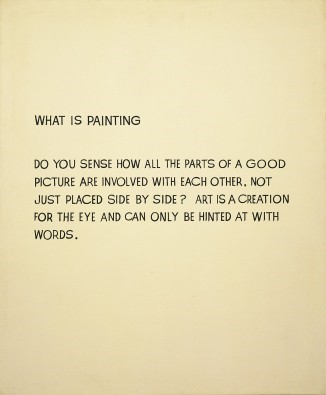
I am mostly inspired by Baldessari’s work from 1966, which mostly consisted of text and photographs on canvas. These works are blank white/cream canvases which hold black upper-case text referring to the artistic practice and how art is made/received. For example, in his piece titled ‘What is Painting’ (1966-68), John Baldessari challenges the subject matter and composition of ‘a good picture’. It also relates to his interest in photography, as suggested by the opening quote.
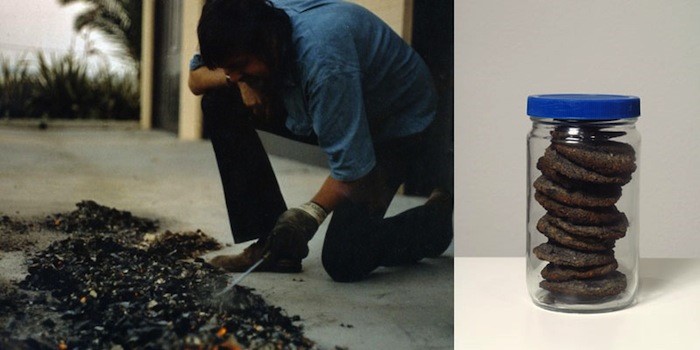
‘The Cremation Project’ was a piece from 1970 by Baldessari and five friends. Baldessari burned paintings he created from 1953-1966 as a way of representing artistic practice and human life. The ashes, which were baked into cookies, were finally placed in an urn and presented as an installation piece. They are honoured by a plaque which labels the paintings death date alongside a recipe for baking cookies. I am interested in Baldessari’s way of signifying the artistic process, and his willingness to be unprecious about his work – something which I need to work on.
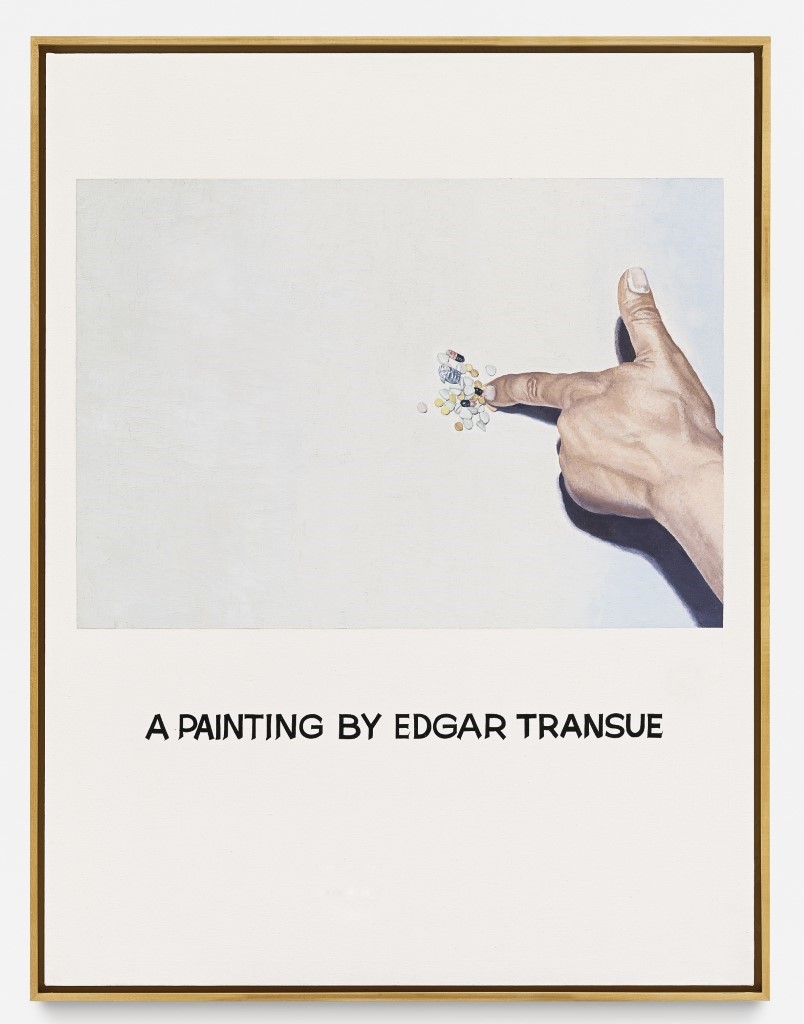
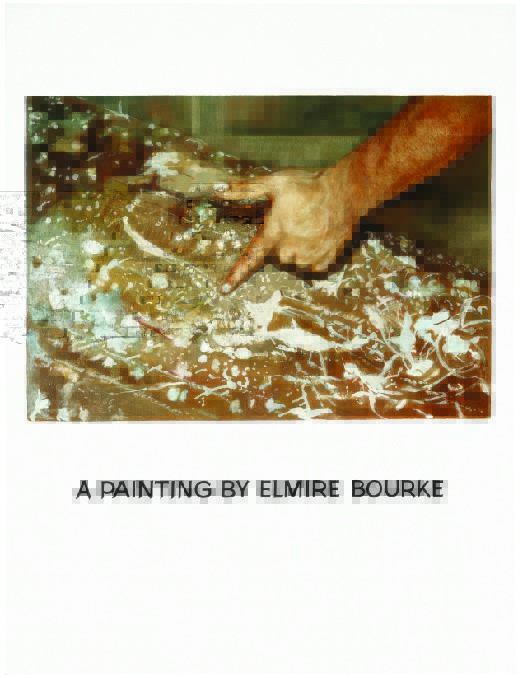
Baldessari also created work which fought back against negative perceptions towards the movement. As conceptual art was becoming a more popular movement, many were quick to speak out against it. As one review from 1969 wrote that conceptual art is ‘nothing more than pointing’, Baldessari played against this by using pointing in his series ‘Commissioned Paintings’, consisting of painted hands literally pointing at objects.
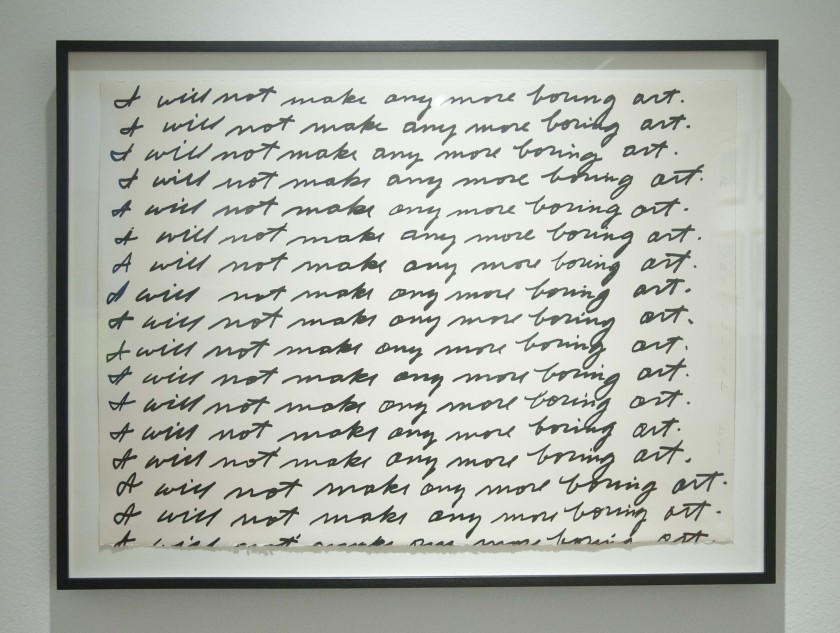
A piece which shows a direct link to my own work was made in 1971 which shows Baldessari’s response to not being able to travel to a show. In this piece, he relied upon students of Nova Scotia College of Art and Design to write ‘I will not make any more boring art’ on the walls of the exhibition.
In 2017, Baldessari released one of his last series, consisting of several large printed emoji symbols. Each poster holds an emoji at large scale, each with their own individual quote or sentence placed below. The use of emojis links to Baldessari’s common use of language in his work and suggests his interest of development in modern communication. He is quoted to have said “The way it started, was when I first saw emojis I thought, ‘How would they look if they were blown up large?’ Which I did and I liked the way they looked. I said, ‘I’m gonna make some paintings with giant emojis.’ And that’s it.” – This greatly inspired my work in my current conceptual project. I was interested by the artists lack of deeper meaning behind parts of the process, and it made me question the significance of meaning behind aspects of artwork. Can an art piece have the same impact if there is no deeper value to the meaning of the work? Does it really matter? Or is the viewers own interpretation the most important part of art? After receiving some feedback, I was questioned on the significance of the material and colours I was using, and was told to consider this in my further work… However, during my research on Baldessari, I started to think if the deeper meaning IS important. Does simply choosing my favourite colours to paint with make me a lesser artist? Does every decision have to have a deeper meaning? I decided to focus my work around these questions.


 ninamcmullanHND