The word ‘quilt’ originates from ‘culcita’ in Latin – translating to ‘stuffed sack’. The name also relates to ‘3 layer stitched cover’. Quilt making can be traced back as far as the late BC years in Asia, as well as recorded existence of similar quilt elements used in Europe worn by the Crusaders to provide warmth, protection, and comfort under their hard armour.
One of the earliest examples of a patchwork quilt is the ‘Tristan Quilt’ (1360-1400).
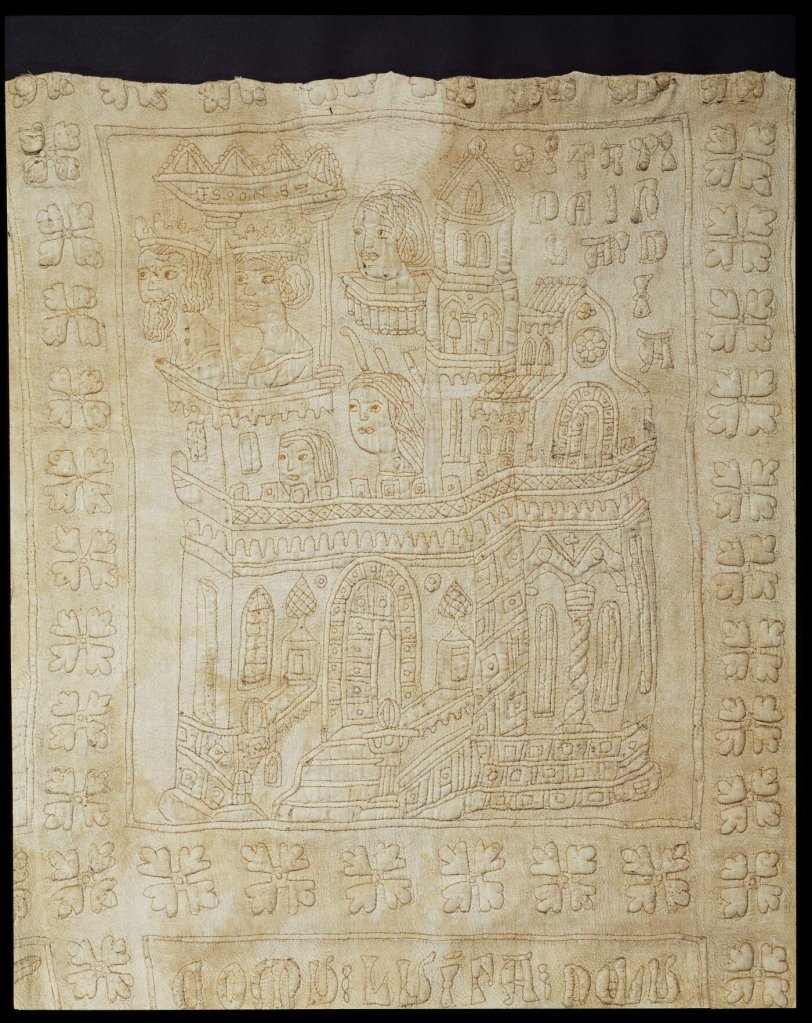
The Tristan Quilt a 14-scene story embroidered on material, depicting of the Battle of Sir Tristan. The neat stitching allows very bold outlines to the subjects, displaying clear imagery meaning it is easy to follow. The quilt measures h:320cm and w:287cm.
Historically, quilts were and still are used for comfort and warmth – whether that be covering a bed or hung in a doorway/over a window to keep out the cold weather. As people began to experiment more with the creation of quilts, more expensive fabrics were introduced – meaning that they were only being bought by the upper class. Those who were slaves and/or housekeepers would create personalised quilts for the household they worked for, embellished with their name/house colours. These quilts were often passed down through generations due to their durability as they were created with a strong foundation of multiple layers of material.
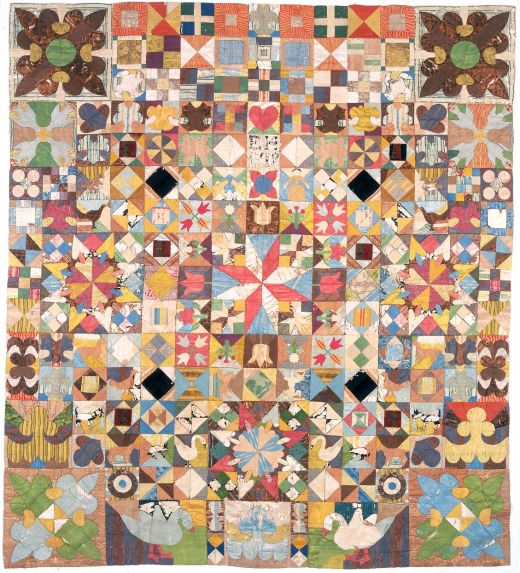
The leftover scraps of material would be kept by the quilt makers to use for their own family – linking to the patchwork appearance we are still familiar with today. These patchwork quilts were filled with colours and shapes created by these small cuts of fabric – giving a new look to the art of quilt making, inspiring future aesthetics in the quilt world. This is clearly displayed in the image below, showing ‘Silk Patchwork Coverlet’, dated 1718.
It is important to mention the social aspect of embroidery and quilt making. The creation process was meaningful amongst women as it was a relaxing social event. After dealing with the challenges of every day life, many women gathered together in their communities and create quilts as a form of escapism. Quilts were also a form of gift celebrating events such as a birth or wedding.
With the development of the sewing machine in the mid 1800’s, quilt making too took a step forward with the new aesthetic possibilities. Hand stitching was no longer needed and therefore the amount of time it usually took to make a quilt improved greatly. With the visual and physical developments of quilt making, quilts became more readily available to a wider range of customer as well as creator.
It was around this time that the technique of quilt making rose to popularity in Britain through clothing. Garments such as petticoats included this form of padding to tackle the British weather – mostly worn by the wealthy. Decorate quilts also became very popular around this time as patterns originating from India were exported to the UK.
The skill of quilt making was useful during the Second World War as women were asked to create quilts to send over to those fighting in the war. Some of these quilts were even auctioned off or included in a raffle as a method of raising money for the Red Cross.
MY THOUGHTS;
After researching and writing about Tracey Emin and her feminist art using quilts, I feel very inspired to try out something similar. I am aware that this is a very time consuming task, so will have to look at ways to create within the amount of time available. I am surprised that the origin of patchwork is routed in slavery, and would like to look into this more to educate myself on the treatment and lives of those during this time period.
 ninamcmullanHND