The art of tapestry can be traced back to thousands of years in multiple cultures. Although little physical evidence remains in most cases, researchers say that the art of tapestry has existed, and been used for multiple purposes over a long period.
The origin of the word tapestry is described as ‘a thick textile fabric in which coloured weft threads are woven (originally by hand) into fixed warp threads to form pictures or designs’. (The Origin and History of Tapestry (tapestriesdirect.co.uk)), with the Latin word ‘Tapetium’ is the Latin word for tapestry being traced back to Greece. The materials used to make tapestries have changed up to this day – with artists mostly now using fine twisted wool and a myriad of textiles, made with modern technology for ease and time purposes, whereas throughout history the beginning of tapestry saw the use of finer materials being made on a loom operated by hand.
The life of tapestry goes way back to 3000 BC when Egyptian tomb paintings displayed drawings of people weaving using a loom. It is also important to note that Egypt started importing their tapestries c. 500 BC to Greece, India and Persia, meaning that creative styles were being passed on all over the world – advancing the physical and aesthetic creation of tapestry. Some of the earliest written examples of tapestry can be found in Exodus, Chapter 26 – the Biblical text that writes of a woven cloth. It is known that woven material was used to tell the stories of the Bible during the 13th and 14th century.
Tapestry in Europe evolved during the mid 13th century as they increased in size meaning they were now more expensive. Many of these commissioned works, often in multiple sets, were made to depict a story of history or current events, created in workshops around Northern France and South Netherlands due to the close location to importation of English wool – as sheep wool was the only type usable on their type of loom.
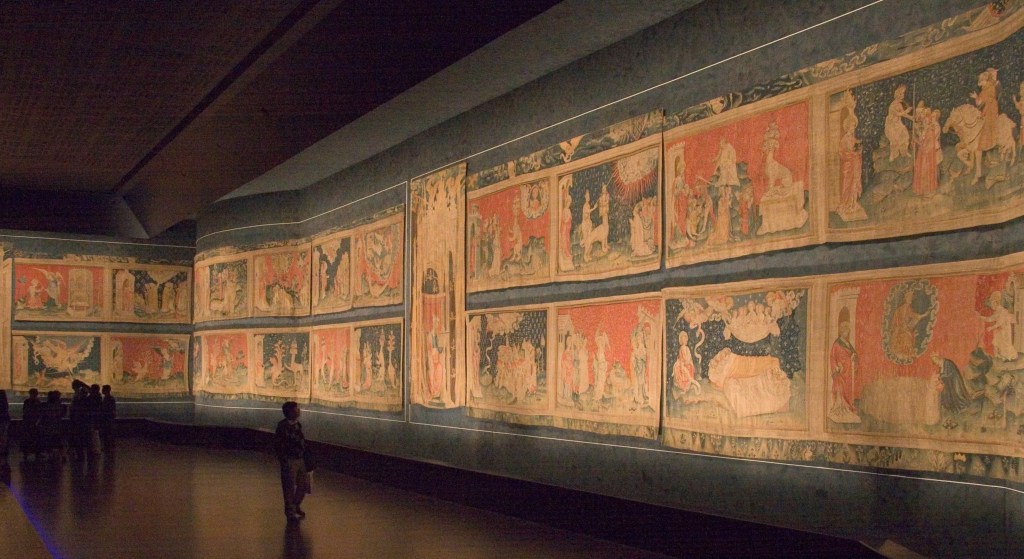
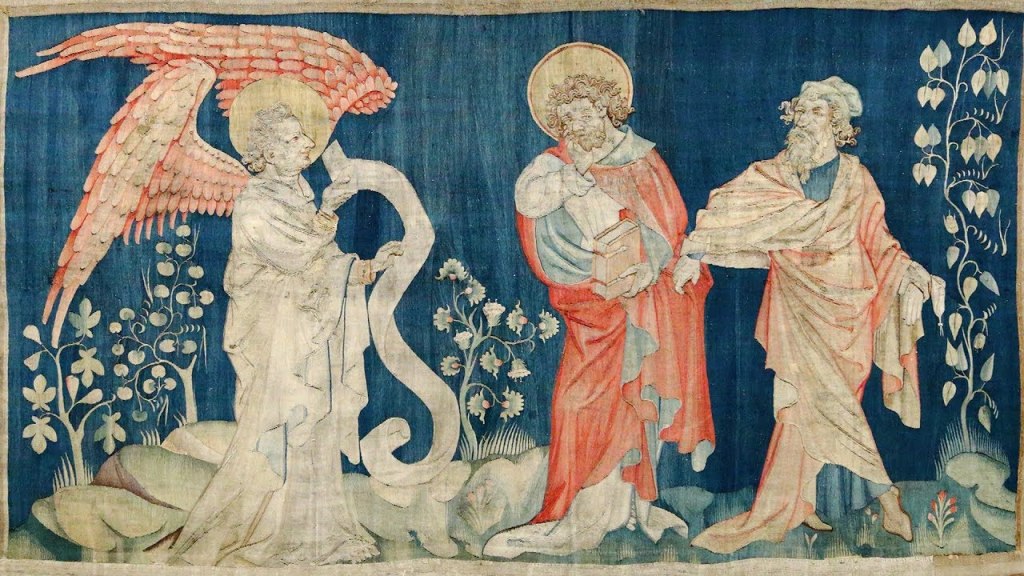
An example of a commissioned tapestry around the late 1300’s by Louis I, which is now known as the ‘Apocalypse Tapestry’. Hennequin De Bruges was ordered to paint miniature Bible stories which would then we woven into 100 separate tapestries Jean Bondol and Nicholas Bataille. It took nine years to finish and is known as the largest Medieval tapestry to this day. The date of this tapestry is crucial as it was created during the 100 years’ war. It is now kept in a French provincial chateau but sadly is seldom visited.
THE LOOM:
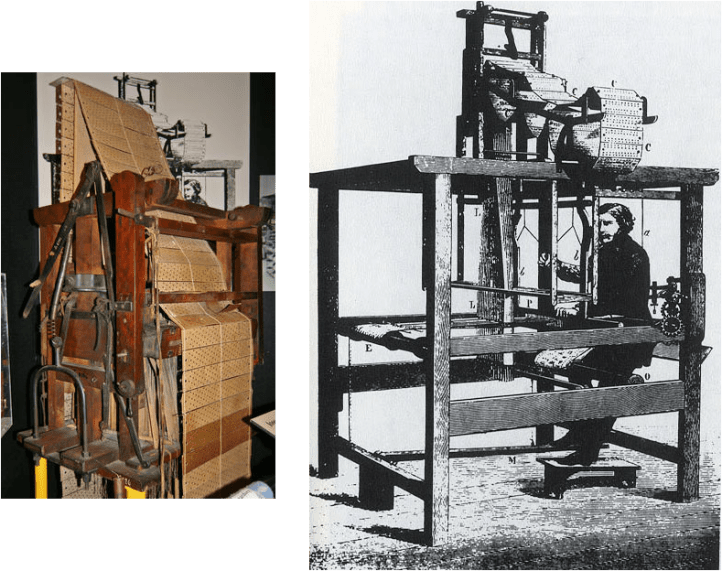
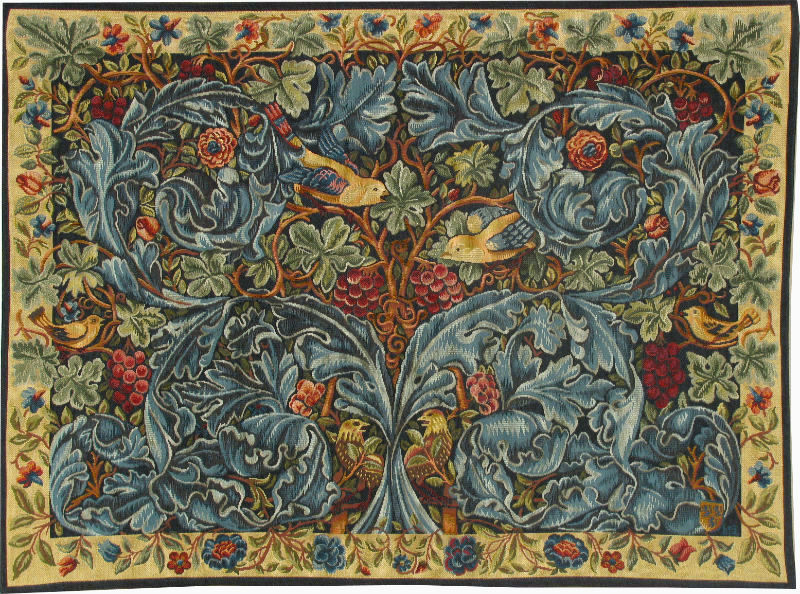
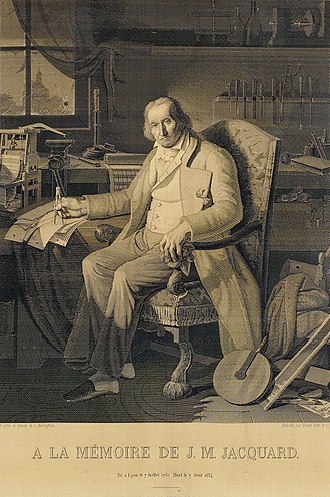
In 1752, Joseph Marie Jacquard was born in France to father Jean Charles Jaqcuard – one of the developers of the loom (now known as the ‘Jacquard loom’), a developed design originally created by Jacques de Vaucanson. His father taught him to weave at just 10 years old – later inspiring him to continue the business of looms after his fathers death in 1772. Sadly, the business was not successful in the beginning but began to raise in popularity after he improved the loom in the early 1790’s. It is this specific method and machine which artist William Morris (British textile artists famous for his repeated floral patterns) used to create his first tapestry titled ‘Acanthus and Vine’ in 1879 in his own bedroom.
[Slideshow content: Jacquard Loom, William Morris’s ‘Acanthus and Vine’, and a weaved portrait of Joseph Marie Jacquard.]
Tapestry is not an easy technique to master, and many made this their lifetime practice. Before the developments of modern machinery, creating a tapestry was a very time consuming and well thought and planned out art form (as well as very expensive to buy).
For years, weavers had to create freehand, although since many have used a guide called the ‘cartoon’. The cartoon is a plan of the tapestry which sits behind the threads to help the artist follow their desired tapestry. The one downfall to this medium is that once you have weaved, you cannot edit it. That means that the tapestries made in early years had to be very well thought out to avoid mistakes.
When tapestries are created using a loom, a thick fabric is woven horizontally to create specific designs which can be gradually depicted as each line of fabric is pushed downwards to tightly weave it together. The closer the fabric, the more intricate the design. Like many hand crafted art forms, the development of technology has had a huge impact on tapestry making, meaning they are now made at mass produced quantities and that looms are less often used.
History of tapestries – tapestry weaving – gobelins wall-hangings (tapestry-art.com)
How Medieval and Renaissance Tapestries Were Made | Essay | The Metropolitan Museum of Art | Heilbrunn Timeline of Art History (metmuseum.org)
 ninamcmullanHND